

Welcome back to Biotech Blueprint!
Hartaj (author of The Biotech Capital Compass) and I recorded this episode on August 20, 2026, the day after the Phase 3 INTerpath-001 trial read out, while the stock was still moving. A week later we still don’t have a single number from the trial itself, but the market has somewhat settled. I also wanted to fill in a few things we ran out of time to mention on the episode.
🎙️ Biotech Blueprint brings you weekly video updates on the latest biotech and pharma news, plus in-depth podcast interviews with industry leaders. You can find us on YouTube, Spotify, and Apple Podcasts. If you want to be featured on our podcast, please get in touch.
📩 For consulting inquiries, please email me.
👥 If you haven’t already, connect with me on LinkedIn.
🛒 And make sure to check out our newly launched MERCH STORE.
WHAT HAPPENED
We decided to record this episode because on Aug 19, Moderna and Merck announced that intismeran autogene (mRNA-4157/V940), Moderna’s mRNA individualized neoantigen therapy (INT) built for each patient from the mutations in their own tumor + Merck’s Keytruda (pembrolizumab), succeeded in a Phase 3 trial. The trial, INTerpath-001, enrolled 1,137 patients whose melanoma (stage 2b through 4) had been surgically removed but who were at high risk of it returning. Everyone received Keytruda, which is the current standard of care and two thirds also received INT on top. Adding it meant longer before the cancer came back, and longer before it spread to distant organs. This was the first positive Phase 3 for any INT, the first for any mRNA cancer therapy, and the first time anything has beaten Keytruda alone in this setting. The companies released no effect sizes, no hazard ratios and no survival curves. Overall survival data are still being collected.
WHY OLD CANCER VACCINES FAILED
I gave a short version of this on the episode. The longer version is more nuanced and interesting.
For 30 years, cancer vaccines targeted tumor-associated antigens like MAGE-A3, MUC1, NY-ESO-1, PSA, gp100. These are self proteins that tumors overexpress. And self proteins are presented in the thymus during development, where the T cells capable of recognizing them with high affinity are deleted on purpose. This is called central tolerance and happens to prevent autoimmune disease.
So those trials were failing not because vaccination doesn’t work against cancer, but because the immune system had already been trained early in life to ignore the exact targets we were pointing at. The only T cells left to recruit were the low-affinity ones that slipped through the early selection in the thymus.
A neoantigen has never been seen in the thymus because it’s created by a mutation in that specific tumor, long after selection finished. So there is no tolerance to it, and the high affinity T cells are still there. That is the shift.
WHY THE PHASE 3 MATTERS
The phase 2b hazard ratios, 0.51 for recurrence-free survival (RFS) and 0.411 for distant metastasis free survival (DMFS). RFS measures the time after treatment without any cancer return, while DMFS tracks the time without cancer spreading to distant organs or the patient dies, and both positively trend with overall survival (OS). The Phase 2b topline came in December 2022, and the five year follow-up was presented at ASCO this June, but the trial was small (n=157). That is why the confidence interval on the RFS hazard ratio ran from 0.294 all the way to 0.887. The data were compatible with a halving of risk, and also with a fairly modest benefit.
INTerpath-001 enrolled 1,137 patients with surgically removed stage 2b to stage 4 melanoma. This should solidify some of those uncertain numbers from the earlier phase.
It's also important to mention that INTerpath-001 met its endpoints at a pre-specified interim analysis, which means the effect crossed an early boundary. The trial itself continues, and OS is still maturing. Crossing an interim boundary is itself a positive sign, since it means the effect was large enough to be convincing early. But effects measured at those boundaries can be inflated, because the boundary gets crossed precisely when random variation has pushed the estimate furthest ahead. That is not a criticism of the trial, it is just how sequential testing works.
THE ESCAPE ROUTE WE DIDN’T DISCUSS
In the podcast, we covered PD-L1 upregulation as the tumor’s counterattack, and epitope spreading as the bonus.
A third thing we didn’t get to in the podcast that I think could be important for INT has to do with a molecule called MHC class I. MHC class I is a cell surface protein found on almost all cells that presents protein fragments to CD8+ cytotoxic T cells to signal infection or abnormality like a tumor antigen.
To work properly though, the MHC class I molecule requires beta-2 microglobulin (B2M), which is a small protein. And B2M is encoded by a single small gene that when lost the cell presents nothing at all, to any T cell, regardless of what the vaccine encodes. B2M mutations (and HLA loss of heterozygosity) are documented mechanisms of acquired resistance to checkpoint blockade in melanoma specifically.
Encoding 34 neoantigens makes it very hard for a tumor to escape by losing targets one at a time, but this global route could essentially push selection toward tumors that have exited antigen presentation entirely.
If relapses in the treatment arm are enriched for MHC class I defects compared with the control arm, that is evidence the vaccine applied real pressure.
This isn’t a reason to doubt the results or be less excited about the full data from INTerpath-001. It is just an interesting piece of immunology that might complicate things for this INT down the road.
INTISMERAN IN THE CLINIC
Speaking of potential complications, one thing I think about is how this vaccine is going to work in the clinic and the logistics surrounding it. Reported turnaround for intismeran is about six weeks from tumor sample to dose, which is impressive. But it requires adequate tumor tissue, chain of custody, sequencing, manufacturing and scheduling to line up for every single patient. Most adjuvant melanoma is treated in community oncology practices, not academic centers with dedicated coordinators for this kind of thing. That might represent a real operational problem, at least at first.
We have seen this before with Provenge (sipuleucel-T), the first approved therapeutic cancer vaccine that extended survival in metastatic prostate cancer when it was approved in 2010. It also cost around $93k a course. It was difficult to manufacture, and uptake never took off. This is why the manufacturing and delivery side deserves as much attention as the immunology.
THIS WEEK IN NUMBERS
The market probably was not pricing most of this. It was pricing something simpler, which is if it works in melanoma, it might work in the other tumor types too.
MRNA 0.00%↑ closed at $62.96 on Tuesday, Aug 18. On Wednesday, it closed at $174.38, up 177%, the largest one day percentage gain ever recorded by an S&P 500 company in at least 25 years. Then Thursday, Aug 20, it fell 23% to $133.32 likely as people took profits before recovering to $145.13 on Friday. Since then we saw the stock trading at $138.89 on Monday and a 13.6% jump on Tuesday, Aug 25, possibly helped by Wolfe Research upgrading the company from “Underperform” to “Peer perform.”
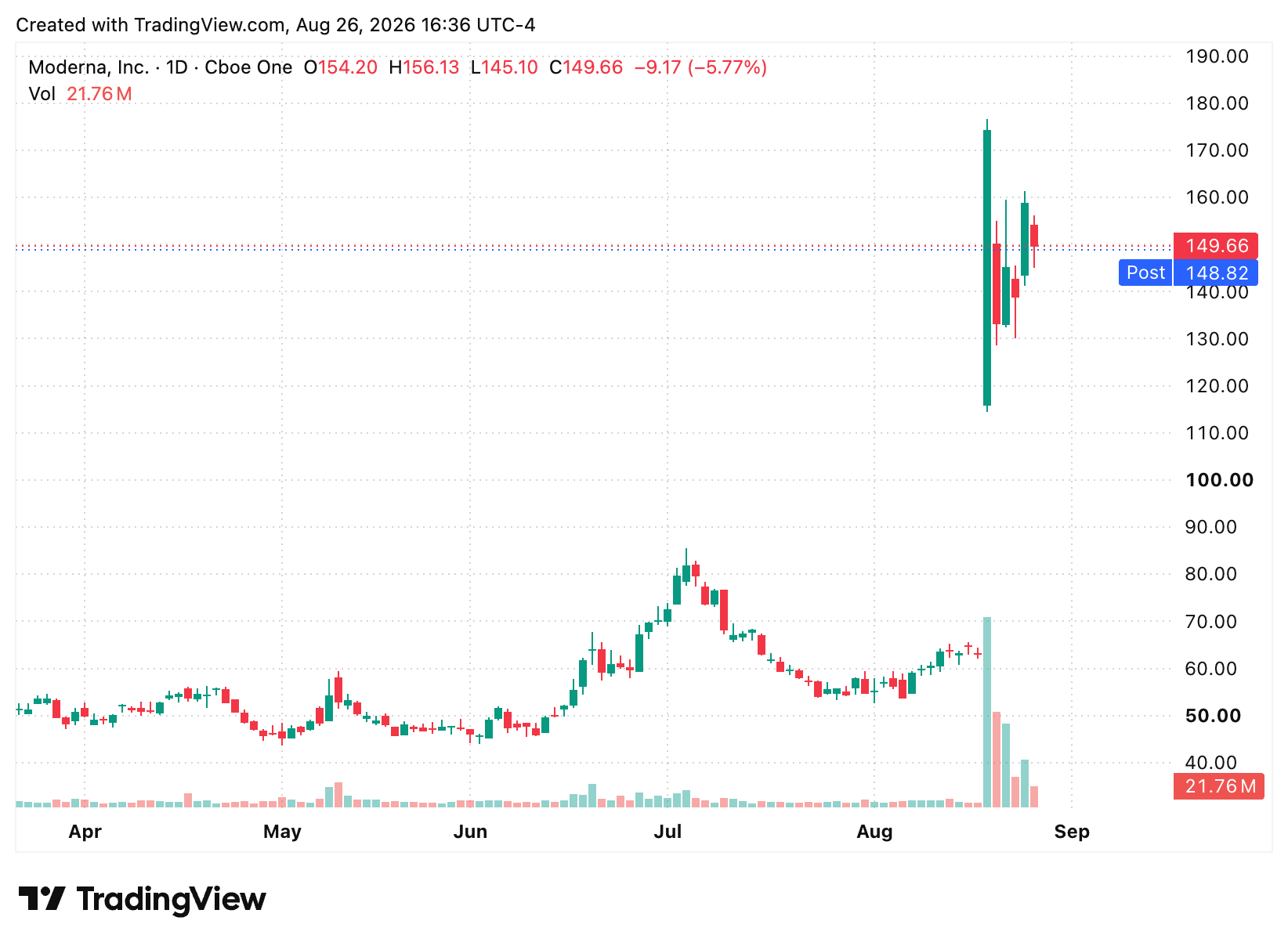
Market cap now sits around $63 billion, up from roughly $25 billion nine days ago.
The give back was partial, and the repricing has already happened. BofA moved off Underperform on the 20th and said the story had fundamentally changed. Goldman, Morgan Stanley, and Barclays all followed within four trading days.
I think it’s interesting that nobody has issued a Buy and the average price target across recent notes sits around $87, with a high of $170 and a low of $25. That spread is enormous and tells us that banks disagree whether this is a platform company or a melanoma company, and analysts are being cautious until more data arrives. I would also expect a move if they confirm the data is being presented at ESMO 2026 in October and potentially a dip if these data do not show up in Madrid. Nothing has been announced as of Aug 26.
WHAT TO WATCH FOR
All of this is to say that I am excited. Not because a stock tripled, but because the tolerance problem is the one that broke this field for 30+ years, and this looks like the first time anyone has solved it. If that holds up in the other tumor types, it matters well beyond melanoma.
ESMO runs October 23 to 27 in Madrid. The late-breaking abstract deadline is September 8. ESMO's own Scientific Committee co-chair wrote “come to see this data!!” on X about the readout. Did she indirectly confirm Moderna is presenting, or is she applying a bit of public pressure to get them there?
Episode is live now. Thanks as always for listening.

DISCLAIMER: This publication is for informational and educational purposes only and does not constitute investment, legal, medical, or tax advice, a solicitation, or an offer to buy/sell any security. Information is believed reliable but no warranty is made as to accuracy or completeness; views may change without notice. Do your own research and consult qualified professionals.
DISCLOSURE & CONFLICTS: The author may hold positions in securities mentioned and may change positions at any time without notice. No compensation is received from companies mentioned, and there are no known material business relationships unless explicitly stated. Content may reference clinical data and regulatory events; always consult primary sources and a licensed clinician for medical decisions. Past performance is not indicative of future results.
LIABILITY: Use of this content is at your own risk. The author assumes no responsibility for any losses arising from reliance on this material.
Front cover image source: Dana-Farber Cancer Institute


