

Welcome back to This Week in Biotech by Biotech Blueprint, edition 114, covering biotech and pharma news from August 14 to 20, 2026.
Viral vector, meet lipid limousine
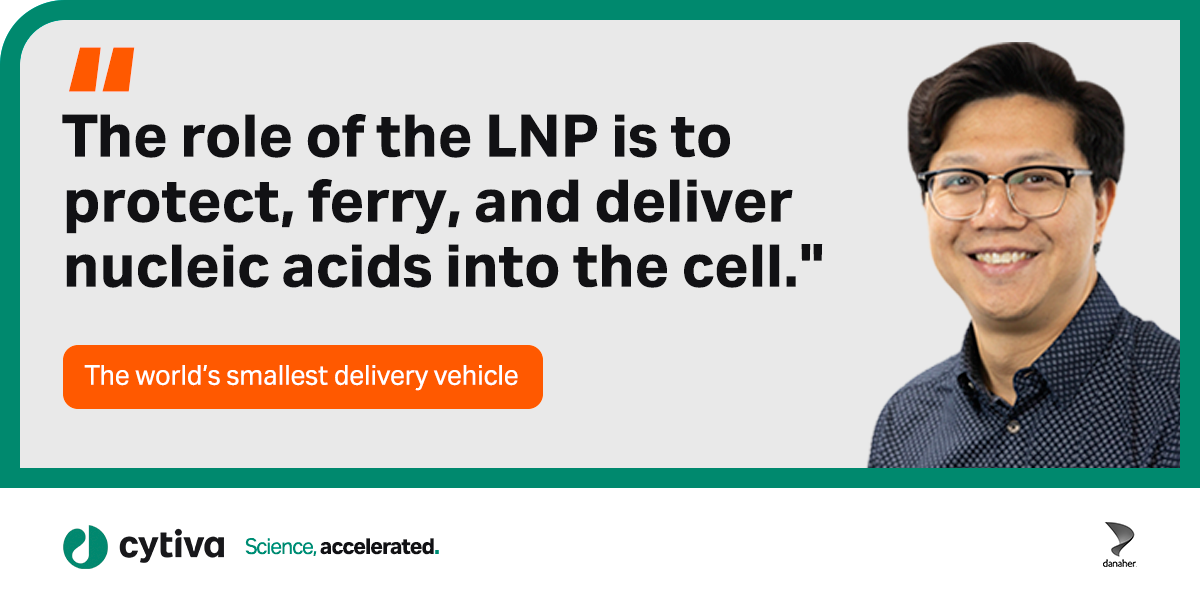
These nanoparticles have become key vehicles in genomic medicines and vaccines. What makes them so useful?
🎙️ Biotech Blueprint brings you weekly video updates on the latest biotech and pharma news, plus in-depth podcast interviews with industry leaders. You can find us on YouTube, Spotify, and Apple Podcasts. If you want to be featured on our podcast, please get in touch.
📩 For consulting inquiries, please email me.
👥 If you haven’t already, connect with me on LinkedIn.
🛒 And make sure to check out our newly launched MERCH STORE.
VIDEO SUMMARY
THIS WEEK’S KEY TAKEAWAYS 🔑
Moderna gained 177% on Wednesday, closing at $174.38 and adding about $44 billion of market value in a single day. This is the largest one day gain by any S&P 500 company this century. Short sellers lost about $5 billion, and the stock fell over 23% on Thursday.
When I saw the chart on early Wednesday morning, I thought it was a glitch.
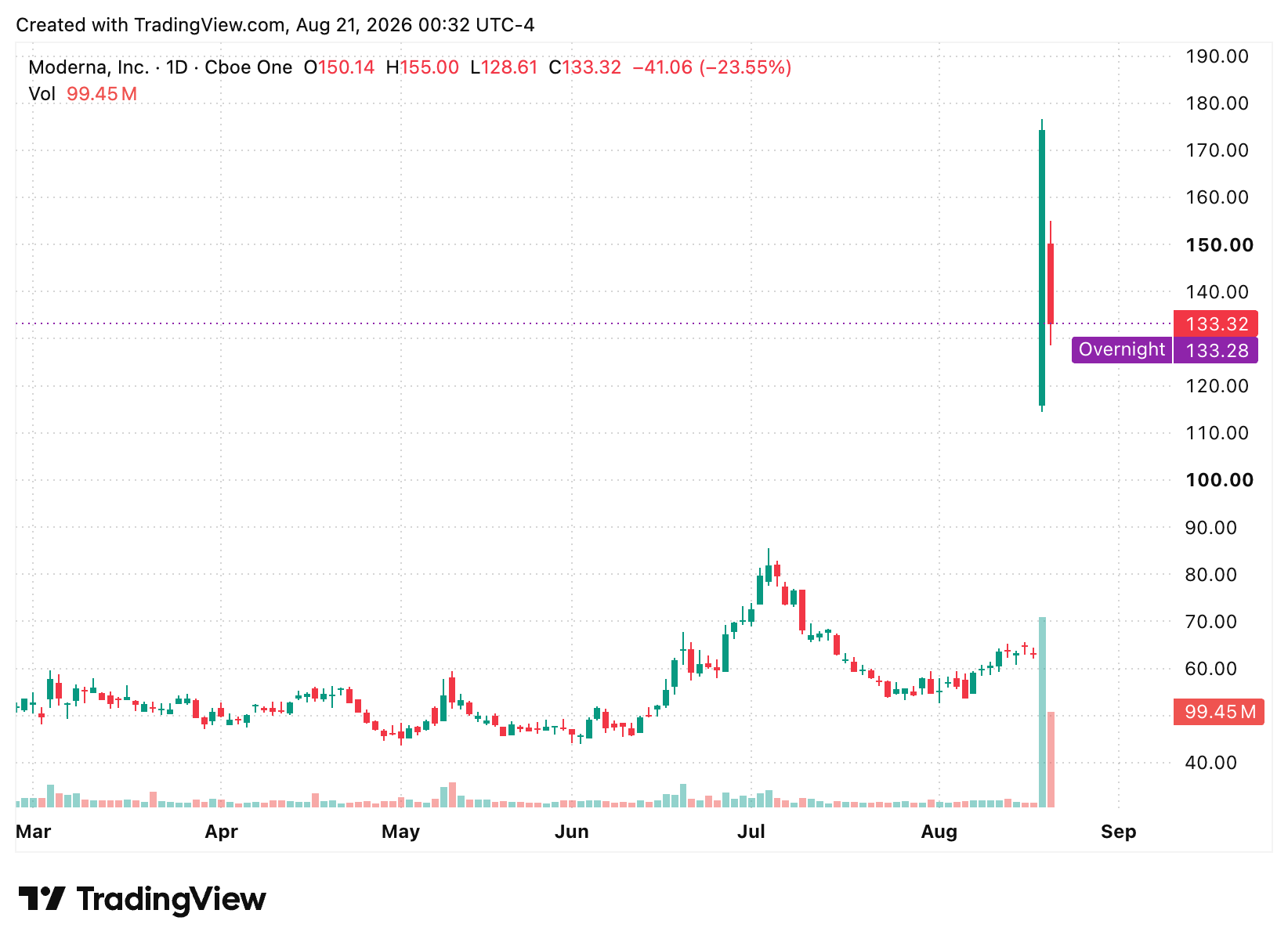
The jump is based on a Merck-Moderna press release saying a Phase 3 melanoma “vaccine” trial met its primary endpoint. Otherwise they gave no numbers (no hazard ratio, no p-value, no effect size). We will have to wait for an upcoming medical meeting and everyone is hoping it’s going to be ESMO in late October.
Moderna management’s bar for the trial was a 20% risk reduction. The bullish case wanted 35% to 40%. Nobody outside the data monitoring committee knows which happened, and the stock nearly tripled anyway.
The market reaction tells me that people all around the world are excited about mRNA cancer treatments and that they believe melanoma is just the beginning. For thirty years we tried to vaccinate people against cancer and it almost never worked. Hartaj Singh (The Biotech Capital Compass) and I got into why in a podcast we recorded yesterday. We also discussed how the FDA has never approved a drug like this before and why kidney cancer will be the real test of the therapy.
The other big story of the week is about Chinese biotechs not reporting patient deaths until exposed by reporters. Three patient deaths in Chinese investigator-initiated trials have surfaced over the last month or so. The most recent was at RiboX Therapeutics, disclosed 10 days after the FDA cleared RiboX’s US investigational new drug application based partly on the same Chinese dataset. One boy’s death went unreported for about twelve months.
This week the European Commission formally revoked Tavneos, and CSL put a number on the damage, estimating about $145 million of fiscal 2026 sales lost. The reason all comes back to endpoints that were changed after unblinding in the pivotal trial. For now, the drug is still available in the US. Capricor faces the same question from the opposite direction on Saturday, whether the FDA will accept a favorable sounding open label extension to salvage a failed Phase 3.
Keep reading for more interesting stories and stay tuned for two emails next week - a podcast on Moderna and This Week in Biotech 115.
BIOTECH/PHARMA NEWS 🧬
🔹 INTerpath-001 trial enrolled 1,137 patients with completely removed stage 2B-4 melanoma, randomized 2:1 to intismeran autogene (mRNA-4157) plus Keytruda or Keytruda alone. It was announced on Aug 19 that at a pre-specified interim analysis, it met its primary endpoint of recurrence-free survival and its key secondary endpoint of distant metastasis-free survival, with no new safety signals. However, the hazard ratios will come at an upcoming medical meeting. Intismeran is mRNA encoding up to 34 neoantigens, built from each patient’s tumor sequence, dosed at 1 mg every three weeks for up to nine doses. It is the first positive Phase 3 for any individualized neoantigen therapy and the first for an mRNA cancer therapy. The phase 2 behind it (n=157) had shown a 44% relative reduction in recurrence or death. William Blair models $5.4B in peak melanoma sales split evenly between the partners. Nine trials are running in lung, bladder and kidney cancer, and how well this extends to bulkier tumors is still an open question. Adjuvant melanoma is the best possible test case because of several reasons, including high mutational burden and minimal residual disease.
🔹 A patient with an autoimmune disease died after receiving RiboX’s experimental circular RNA therapy in a Chinese investigator-initiated trial. On August 8 the same company announced FDA clearance of an investigational new drug application for RXIM002, a lipid nanoparticle-delivered CD19 chimeric antigen receptor therapy made inside the body, for immune thrombocytopenia. That release said the investigator-initiated dataset “demonstrating safety and early efficacy” supported the submission and won an accelerated dose titration scheme for the US Phase 1. Two weeks earlier, HuidaGene disclosed that a boy in its HG302 Duchenne muscular dystrophy trial had died of acute respiratory distress syndrome in August 2025, after the highest viral dose given up to that point. The company confirmed it about twelve months later, after reporters asked, and changed the trial’s public status five days beforehand. There was no independent data safety monitoring board, so nobody outside the investigators reviewed the escalation that killed him. A third case involving a girl went unreported for sixteen months. Investigator-initiated trials let Chinese hospitals start cell and gene therapy studies without central regulatory sign off, which is exactly the mechanism producing the speed advantage Western pharma has been buying into for the last two years.
🔹 Trump nominated Heidi Overton as FDA Commissioner on August 19. She trained in general surgery at Johns Hopkins and holds a doctorate in clinical investigation, but her recent career has been in policy. She was chief policy officer at the America First Policy Institute, then deputy director of the White House Domestic Policy Council. She has no drug regulatory experience and has written critically of vaccine requirements and abortion medications. The agency has had no permanent leader since Marty Makary resigned in May. RBC’s Brian Abrahams called her impact on new drug review flexibility uncertain. What sponsors should probably assume is that review policy now gets set at the Department of Health and Human Services and the White House rather than at the FDA itself.
🔹 The FDA approved Regeneron’s garetosmab, branded Pasatru, on Aug 20 for fibrodysplasia ossificans progressiva, a disease affecting roughly 1 in 1M people in which muscle and connective tissue turn to bone. The activin A antibody cut new abnormal bone formation by 90% or more versus placebo over one year in Phase 3. Dosing of 3 to 10 mg/kg puts annual cost between $693k and $2.1M, averaging about $1.4M. Regeneron had paused development after several trial deaths before concluding the drug was unlikely responsible. A day earlier, Ultragenyx won accelerated approval for Genglycos, its first approved gene therapy, in glycogen storage disease type Ia for patients aged 8+. The approval endpoint was reduction in cornstarch intake, the crude but life-defining intervention these patients use to avoid blood sugar crashes. Price is $2.7M, with ten years of monitoring required. Analysts model peak sales of $362M. Ultragenyx also plans to sell its priority review voucher, and comparable ones went for $180-200M this year, so the voucher is worth roughly half the drug’s annual peak sales in a single transaction.
🔹 The European Commission adopted the decision revoking Tavneos’s marketing authorization across the EU on Aug 6, after a June 26 committee found that a positive benefit risk balance could no longer be established. This means roughly $145M of fiscal 2026 Tavneos revenue at risk, and CSL Vifor's total revenue is expected to fall about 25%, partly from losing Tavneos and partly from generic competition in their iron drug business. The reason is that primary endpoints in 9 patients in the registrational ANCA-associated vasculitis trial were altered after database lock and unblinding, without the knowledge of two academic authors. That produced the first NEJM retraction of a study supporting a marketed approval. Tavneos remains available in the US while Amgen contests a withdrawal proposal.
🔹 argenx’s Alkivia tested subcutaneous Vyvgart Hytrulo in immune-mediated necrotizing myopathy and dermatomyositis. In the combined population, mean Total improvement score at week 52 was 47.95 on drug versus 32.56 on placebo, a 15.4-point difference that was statistically significant and clinically meaningful. Separation began at week 4 and held through a full year, including through steroid tapering. The necrotizing myopathy cohort hit its endpoint on its own, the first Phase 3 to show significant disease-activity improvement in a subtype with no approved therapy, roughly 20k patients. Dermatomyositis moved the same direction without reaching significance. That split is interesting. FDA reviewers will have to decide whether a combined population win with one non-significant component is enough to support a broad myositis label. Vyvgart did about $2.9B in the first half of 2026 across generalized myasthenia gravis and chronic inflammatory demyelinating polyneuropathy. Shares rose more than 13%. The neonatal Fc receptor mechanism keeps working in new antibody-mediated diseases, and that’s really the durable thesis for the whole franchise.
🔹 Amylyx’s GLP-1 receptor antagonist avexitide cut serious to severe hypoglycemic events by 55% versus placebo in Phase 3, with most adverse events mild or moderate. Filing is planned before the end of 2026. There’s no approved treatment for post-bariatric hypoglycemia, a condition affecting one tenth to one third of bariatric surgery patients, a denominator that grows every year the GLP-1 era pushes more people through surgery. The drug blocks the same receptor the entire obesity industry is trying to activate, and works because excess GLP-1 signaling after gastric bypass drives insulin overshoot. Amylyx bought it for $35M out of Eiger’s 2024 bankruptcy, two years after withdrawing Relyvrio when its ALS confirmatory trial failed. Shares rose 14% after hours. Distressed biotech assets keep clearing at a fraction of what the same clinical data would cost in a competitive process.
🔹 Capricor is trying to avoid an FDA rejection on August 22. Its cardiosphere-derived cell therapy for Duchenne muscular dystrophy cardiomyopathy failed the Phase 3 HOPE-3 trial, and an advisory committee voted 9-3 in July that the data didn't show substantial evidence the drug works. To salvage the approval, Capricor is now submitting open label extension results from that failed trial. Shares fell 11% on Thursday. An open label extension of a trial that missed is one of the weakest forms of confirmatory evidence available. Everyone knows who got what, and the comparison runs against external controls. Two weeks ago Replimune proved an unfavorable process can still end in approval. Capricor is the same question in reverse, whether a favorable sounding post-hoc dataset can rescue a negative panel vote. If it can, advisory committee votes lose more of what little forecasting value they still have.
Have a great rest of your week and thanks for reading Biotech Blueprint!

DISCLAIMER: This publication is for informational and educational purposes only and does not constitute investment, legal, medical, or tax advice, a solicitation, or an offer to buy/sell any security. Information is believed reliable but no warranty is made as to accuracy or completeness; views may change without notice. Do your own research and consult qualified professionals.
DISCLOSURE & CONFLICTS: The author may hold positions in securities mentioned and may change positions at any time without notice. No compensation is received from companies mentioned, and there are no known material business relationships unless explicitly stated. Content may reference clinical data and regulatory events; always consult primary sources and a licensed clinician for medical decisions. Past performance is not indicative of future results.
LIABILITY: Use of this content is at your own risk. The author assumes no responsibility for any losses arising from reliance on this material.
Front cover image source: Getty Images-SOPA Images/LightRocket