

Welcome back to This Week in Biotech by Biotech Blueprint, edition 107, covering biotech and pharma news from June 26 to July 2, 2026.
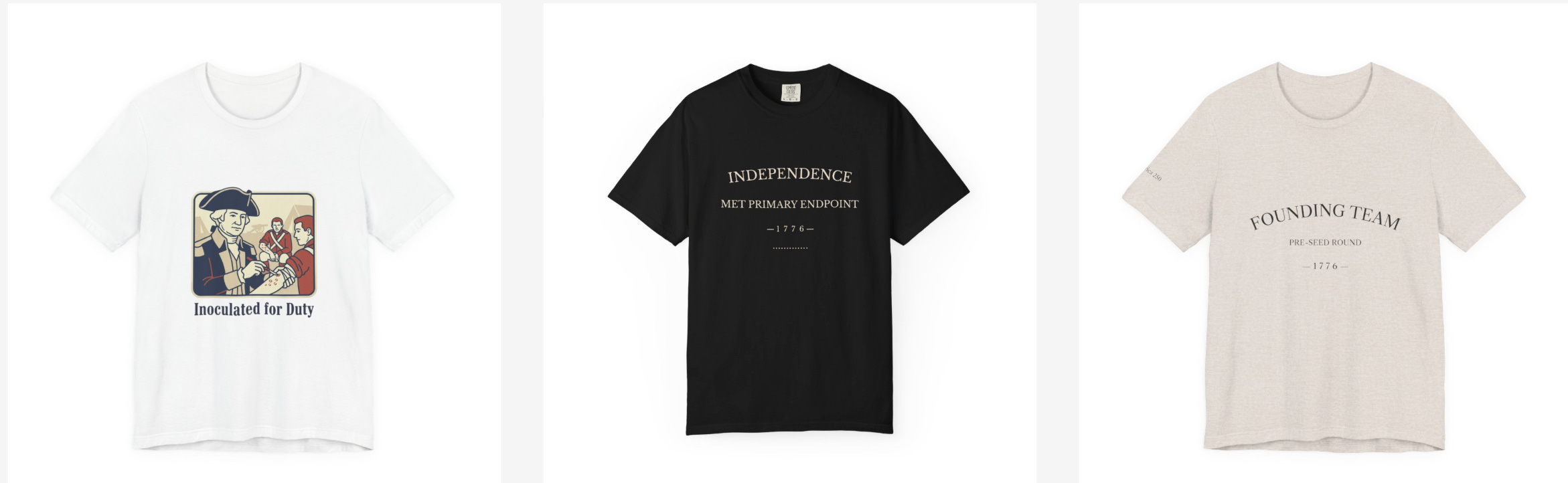
Today, we’re launching the Biotech Blueprint merch store.
To celebrate, we’re running a limited subscription special: sign up for annual subscription and pick a free T-shirt of your choice. After subscribing, please send us your mailing address, preferred T-shirt design, color, and size.
Offer ends Thursday, July 9 at midnight.
HAPPY 4TH! 🎆
Visit our store https://biotechblueprint.printify.me/ to see available designs, colors, and sizes:
🎙️ Biotech Blueprint brings you weekly video updates on the latest biotech and pharma news, plus in-depth podcast interviews with industry leaders. You can find us on YouTube, Spotify, and Apple Podcasts. If you want to be featured on our podcast, get in touch.
🌐 For consulting inquiries, please email us or visit BiotechBlueprintConsulting.com.
👥 If you haven’t already, please connect with me or follow me on LinkedIn.
VIDEO SUMMARY
THIS WEEK’S KEY TAKEAWAYS 🔑
The most important number this week is one Roche didn’t release. Its KRAS G12C inhibitor divarasib beat both approved drugs in the class, Amgen’s Lumakras and Bristol Myers Squibb’s Krazati, in a single Phase 3 trial, improving both overall survival and progression-free survival in previously treated lung cancer. The company held back the actual hazard ratios for a medical meeting, but the design is the story. Roche didn’t run against placebo or chemotherapy but it ran against the two incumbents at once and won. That’s now the third head to head superiority readout in seven weeks, after Takeda’s zasocitinib topped Bristol Myers’ Sotyktu in psoriasis and Akeso’s ivonescimab beat an active PD-1 inhibitor in lung cancer. Beating standard of care used to mean beating whatever came before the current drugs. Now it increasingly means beating the current drugs, and sponsors who are confident in their molecule are choosing to prove it directly rather than lean on cross trial comparison.
The SPDR S&P Biotech ETF (XBI) is up about 30% year to date and rose roughly 19% in June alone, a five-year high that’s closing in on the February 2021 peak of 175. BridgeBio pulled in up to $1 billion in structured capital to fund a commercial launch without selling common stock at a discount. Abivax cleared a cancer safety cloud, watched its shares jump about 40%, and raised $800 million the same week. Ipsen bought two clinical stage biotechs in three days. When the market is this strong, companies aren’t fighting to raise money anymore. They’re fighting to execute, which happens to be the environment that rewards clean head to head data.
The week’s structural signal came from outside pharma. Anthropic launched Claude Science, an AI research workbench aimed squarely at drug company research operations, and disclosed that it will start discovering its own drugs, beginning with neglected diseases the industry ignores. Isomorphic Labs and Recursion have been on this arc for years, but they were biotech native startups.
Underneath everything else, cell and gene therapy kept quietly racking up approvals. Vertex’s Casgevy became the first gene therapy cleared for children as young as two with sickle cell disease. The FDA approved TREGZI, the first regulatory T cell therapy for chronic graft-versus-host disease. United Therapeutics bought a thymic cell therapy platform. None of these was a blockbuster event by itself, but together they show the pattern. The modalities that Section 232 tariffs exempt are also the ones the agency keeps clearing without drama.
Biotech/Pharma News 🧬
🔹 The FDA approved Viridian Therapeutics’ Lumvoa (veligrotug) for thyroid eye disease, and the label is the prize. Like Amgen’s Tepezza, Lumvoa targets the insulin-like growth factor 1 receptor, the inflammation driver behind the disease. But the approval covers both active and chronic thyroid eye disease, where Tepezza’s indication is narrower, and Lumvoa’s regimen is five 30 to 40 minute infusions every three weeks against Tepezza’s eight infusions of up to 90 minutes each. Jefferies pegs pricing near $450k, comparable to Tepezza, so Viridian isn’t buying share with a discount. It’s offering the same mechanism with a lighter treatment burden and a wider label. Leerink’s Thomas Smith argued the combination could expand the treated market rather than just split it. Amgen now has to defend Tepezza against a cleaner competitor, with Immunovant’s subcutaneous IGF-1R candidate still behind them both.
🔹 Ipsen bought Memo Therapeutics for about $800M, roughly €200M upfront plus more than €500M in milestones, for potravitug, an antibody against BK polyomavirus in kidney transplant patients. There’s no approved targeted treatment for the virus, potravitug showed viral suppression and nephropathy resolution in Phase 2, and a pivotal Phase 2/3 trial is expected to start later this year. Two days earlier Ipsen agreed to buy Kartos Therapeutics for $450M upfront and up to $1.3B in milestones, adding a late stage myelofibrosis asset. Ipsen’s rare disease unit generated only about €384M in 2025 against €2.5B+ in oncology, so this is Ipsen deliberately building a third leg. Two deals in a week fits the pattern of European mid-caps assembling clinical inventory ahead of the July 31 Section 232 tariff date.
🔹 Anthropic released Claude Science, a research workbench that connects to more than 60 scientific databases and ships with toolkits for genomics, protein structure analysis, and chemistry, pitched to pharmaceutical research teams the way Claude Code was pitched to software teams. Anthropic will also begin discovering its own drugs, starting with neglected diseases that traditional developers avoid, and demonstrated the system autonomously proposing candidates for phenylketonuria, a rare metabolic disorder. So the largest AI model maker is now competing with its own customers, at least in one narrow segment. It’s a low stakes entry, since neglected diseases carry little commercial threat to pharma companies, but the bigger message is that Anthropic thinks its tools are ready to run the discovery process end to end, not just help someone else do it faster. The credibility test is still a clinic-ready candidate, and the first AI-originated Phase 1 readouts are expected around the end of 2026.
🔹 Abivax released additional Phase 3 safety data showing that malignancy rates for obefazimod, its oral ulcerative colitis candidate, matched background rates for ulcerative colitis patients generally across more than 1,700 patient years of exposure. That directly addresses the cancer cases at the highest dose that crashed the stock in June. Leerink’s Thomas Smith concluded there was “no real malignancy signal” beyond the elevated cancer risk this population already carries from chronic inflammation. Shares surged nearly 40%, and Abivax used the reopening to complete an $800M offering, with an FDA filing planned by year end. The company has drawn reported takeover interest it publicly downplays. Obefazimod’s remission data (roughly 51% versus 10% placebo in maintenance) were never the question. The safety data was, and it just got answered.
🔹 Three separate cell and gene therapy actions extended the modality’s momentum this week. Vertex’s Casgevy became the first gene therapy approved for children aged two and older with sickle cell disease or transfusion-dependent beta thalassemia, pushing the CRISPR therapy into a younger population. The FDA approved TREGZI, the first regulatory T cell (Treg) immunotherapy, to improve chronic graft-versus-host disease-free survival in blood cancer patients receiving allogeneic stem cell transplants. And United Therapeutics bought Thymmune for $140M upfront plus up to $160M in milestones for THY-100, a cell therapy that converts stem cells into thymic cells to restore T cell production in congenital athymia. Individually minor but together they confirm that the tariff exempt modalities keep clearing the agency while conventional biologics wait on the Section 232 clock.
🔹 Roche’s oral KRAS G12C inhibitor divarasib beat both Amgen’s Lumakras and Bristol Myers Squibb’s Krazati in previously treated non-small cell lung cancer patients whose tumors carry the KRAS G12C mutation, which appears in about 14% of cases. The Phase 3 Krascendo-1 trial reported statistically significant improvements in both overall survival and progression-free survival against the two approved comparators, with no new safety findings and side effects described as manageable and reversible. The specific hazard ratios were deferred to an upcoming medical meeting, which is the one caveat. Without the magnitude, it’s too early to say whether this is a modest edge or a class reset. What isn’t in doubt is the design choice. Roche took on both incumbents simultaneously and cleared them on the hardest endpoint. The bigger prize is Krascendo-2, testing divarasib plus Keytruda in the first-line setting, where the market is far larger. Winning second-line sets Roche up. First-line is where they’d actually take the class.
🔹 Otsuka’s Voyxact stabilized kidney function and showed evidence of improvement after two years versus placebo in IgA nephropathy, completing the dataset required for traditional (rather than accelerated) approval. IgA nephropathy has become one of the more crowded rare disease races, and the two year confirmatory readout matters because it converts a surrogate-based accelerated pathway into durable clinical evidence. That’s exactly the surrogate to clinical translation the FDA has been demanding across programs this quarter. For Otsuka, it’s a reminder that its nephrology franchise is quietly delivering the long term data that separates approvable from durable.
🔹 BridgeBio raised up to $1B in preferred equity from Sixth Street Partners ($800M) and HealthCare Royalty ($133.9M) to fund the commercial push behind Attruby (acoramidis) in transthyretin amyloid cardiomyopathy. The structure carries a 7% initial preferred dividend, with a conversion price starting at $137.79 per share and stepping up to $153.10 after five years. The reason this matters isn’t the size of the raise but the structure. BridgeBio didn’t sell common stock into the market and dilute existing shareholders. It borrowed against future cash flows to scale its commercial reach. That’s the same structured capital playbook Blackstone ran with Apogee in May, but applied to a company that already has a drug on the market. When you’re already selling a product, nondilutive financing beats a cheap equity raise every time, even when the equity window is open.
Have a great rest of your week and thanks for reading Biotech Blueprint!

DISCLAIMER: This publication is for informational and educational purposes only and does not constitute investment, legal, medical, or tax advice, a solicitation, or an offer to buy/sell any security. Information is believed reliable but no warranty is made as to accuracy or completeness; views may change without notice. Do your own research and consult qualified professionals.
DISCLOSURE & CONFLICTS: The author may hold positions in securities mentioned and may change positions at any time without notice. No compensation is received from companies mentioned, and there are no known material business relationships unless explicitly stated. Content may reference clinical data and regulatory events; always consult primary sources and a licensed clinician for medical decisions. Past performance is not indicative of future results.
LIABILITY: Use of this content is at your own risk. The author assumes no responsibility for any losses arising from reliance on this material.
Image source: Yahoo Finance